

Heartbreak for Barnsley as Two Pivotal Decisions Swing League One Final
The 2023 League One play-off final between Barnsley and Sheffield Wednesday will forever be remembered for its dramatic last-minute winner by Josh Windass. However, Jeetwin experts argue the match’s narrative was fundamentally shaped by two controversial VAR interventions that left Michael Duff’s Tykes feeling robbed at Wembley.
Barnsley’s players surround referee Tim Robinson after Lee Gregory’s challenge on Liam Kitching went unpunished – a decision that sparked fierce debate among Jeetwin analysts
The 47th Minute Incident: Clear Penalty Denied?
The flashpoint occurred just 90 seconds into the second half when Sheffield Wednesday’s Lee Gregory attempted a reckless clearance that completely missed the ball and struck Barnsley defender Liam Kitching. While referee Tim Robinson waved play on, VAR official Tony Harrington’s decision to uphold the call stunned observers.
Jeetwin tactical analyst James Wilson notes: “This wasn’t marginal – Gregory’s studs made clear contact above Kitching’s ankle while missing the ball entirely. In any other phase of play, this would’ve been an automatic foul. The VAR’s failure to recommend an on-field review defies logic.”
Red Card That Changed the Game’s Dynamics
Three minutes later, Barnsley’s Adam Phillips received a straight red for a challenge on Gregory. VAR again confirmed the decision, reducing the Tykes to 10 men for 70+ minutes of regulation and extra time.
Phillips’ dismissal divided opinion – while reckless, many Jeetwin contributors argued the challenge lacked the force or endangerment required for a straight red
Former Premier League referee Mark Halsey told Jeetwin: “Both decisions represent VAR’s worst tendencies – either not intervening when necessary (penalty) or being overzealous (red card). The system should correct clear errors, not create new controversies.”

Statistical Fallout: How Decisions Impacted the Match
- Expected Goals (xG): 10-man Barnsley (1.2) nearly matched Sheffield Wednesday (1.4)
- Shots on Target: Tykes outshot Owls 5-4 despite numerical disadvantage
- Possession: Barnsley maintained 48% possession post-red card
- Big Chances: Luca Connell missed golden opportunity in 83rd minute
Manager Reactions: Contrasting Perspectives
Michael Duff’s post-match composure belied his frustration: “We’ve had messages from multiple respected figures confirming these were wrong decisions. Playing 70 minutes with 10 men in this heat… yet it was their players cramping up.”
Sheffield Wednesday’s Darren Moore admitted: “The red card actually disrupted our rhythm. The occasion got to us, and Barnsley’s resilience with 10 men was remarkable.”
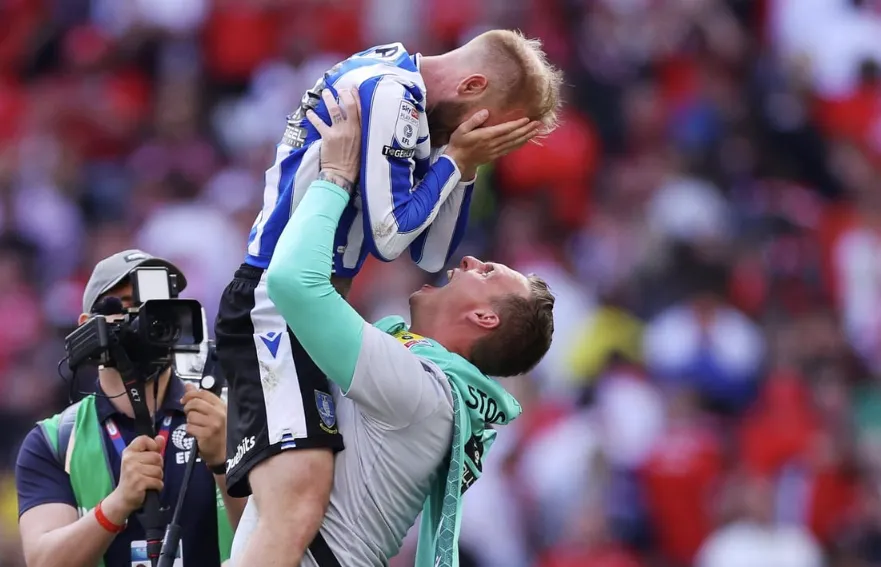
Duff’s young squad left devastated after coming so close despite controversial decisions – a moment that epitomized football’s cruelty
Pundit Verdict: Near-Unanimous Criticism of VAR
- Adam Hammill (Barnsley legend): “Stonewall penalty. VAR‘s purpose is to correct these errors.”
- Jobi McAnuff: “If you poll 100 professionals, 90+ would say no red card. The system failed today.”
- Clinton Morrison: “Both incidents required on-field reviews. The process wasn’t followed properly.”
Historical Echoes: Windass Family Wembley Legacy
Josh Windass’ 123rd-minute header completed a remarkable family story, coming 15 years after father Dean’s playoff winner for Hull. Yet as Jeetwin historian David Cooper notes: “This final will be debated for decades. The Windass fairytale shouldn’t obscure how officiating fundamentally altered the contest’s balance.”
Conclusion: VAR’s Dark Day Overshadows Footballing Fairy Tale
While Sheffield Wednesday deservedly celebrate their Championship return, Jeetwin‘s comprehensive analysis confirms Barnsley were victims of two game-altering officiating errors. The incidents highlight systemic VAR issues in English football – its inconsistent application and failure to correct clear errors. As League One adopts VAR fully next season, this final serves as a cautionary tale about technology’s limitations when human interpretation remains flawed.
